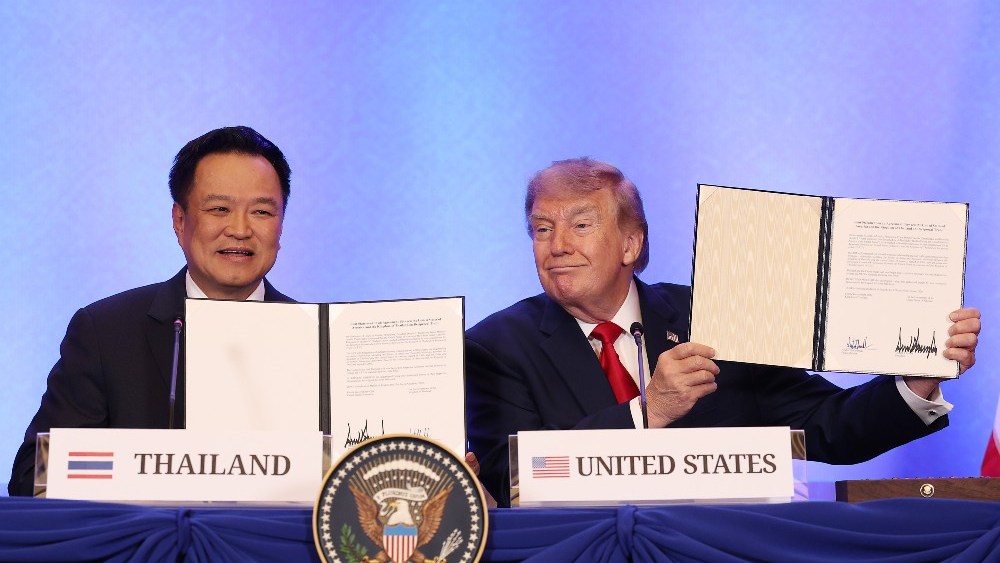
President Donald Trump’s trip to Asia this week yielded a deal with Thailand that will provide American makers and corporations with “unprecedented levels of market access,” eliminating duties on 99 percent of goods from the United States, according to the White House.
The tradeoff, Thailand’s government said, is that the country will see its Section 301 forced labor tariff rate reduced from 12.5 percent to 10 percent to mirror the duties faced by neighboring Cambodia, Malaysia and Indonesia.
Thailand Commerce Minister Suphajee Suthumpun announced the development on Wednesday, one day after Trump met with Thailand’s Prime Minister Anutin Charnvirakul on Tuesday on the sidelines of the ASEAN Summit in Manila and ceremoniously signed the reciprocal trade agreement.
The White House released its own statement that did not include an announcement of a reduction of Section 301 tariffs on Thailand, though it did say that the country has committed to improving conditions for workers by amending its law to strengthen protections and that it will address any violations in sectors with a high risk for forced labor and child labor.
The U.S. will maintain a 19 percent reciprocal tariff on Thai goods that was established during framework negotiations in October 2025, though the government will identify products from last year’s list for potential tariff reductions to as low as zero percent.
The U.S. represents Thailand’s biggest export market, having shipped $70.2 billion worth of goods to American shores last year. But according to the White House, Thailand represents America’s 11th largest goods trade deficit, worth about $45 billion in 2024.
As such, the U.S. has now successfully pushed the country to open selective portions of its market while maintaining certain import limits and safeguards to domestic industry. In addition to drawing down duties on the vast majority of U.S. products, Thailand has committed to buying U.S. vehicles, and $2.6 billion in additional American agricultural products.
The countries said they would finalize commitments to remove barriers for digital trade, like services taxes that “discriminate” against U.S. products. Thailand committed to addressing “long-standing intellectual property issues, including regarding enforcement against trademark counterfeiting and copyright piracy,” as well as taking steps to work with the U.S. on mutually addressing unfair trade policies, cooperating on export controls and addressing duty evasion.
The White House said the two countries would continue negotiations over the coming weeks to “lock in” benefits for U.S. businesses. Thai representatives said legal counsel is slated to spend about two months finalizing the agreement before it’s submitted to the Thai cabinet.
“This is an incredible victory for both countries, both the people of Thailand and the American people, and I look forward to finalizing the details of our formal agreement in the coming weeks,” Trump said.
“Thailand attaches great importance to its long-standing relationship with the United States,” Charnvirakul said at the signing. “Our partnership is beyond trade and investment. We remain committed to strengthening our cooperation across areas of mutual interest.”
Trump subsequently traveled to Shenzhen, China for the Asia-Pacific Economic Cooperation (APEC) forum and a highly anticipated meeting with Chinese President Xi Jinping and Russian President Vladimir Putin on Thursday.
There was speculation that the occasion might afford a chance for Trump and Xi to continue their discussion about the future of U.S.-China trade after extending last year’s Busan trade truce for three months in September, but little headway appears to have been made on that front as the conversation was characterized as “an in-depth exchange of views on the current international situation and committed to maintaining strategic stability and international security.”
Trump is slated to meet Xi face-to-face again in December for the G20 Leaders’ Summit on Dec. 14–15 at the Trump National Doral golf club in Miami.
In addition to committing to “reform the UN” so that it can respond more effectively to global challenges, the leaders this week promised to maintain a dialogue about reducing nuclear risks and preventing the proliferation of nuclear weapons. Notably, they also announced plans to up the production of refined petroleum products to create “stable energy flows” for “the benefit of all nations.”