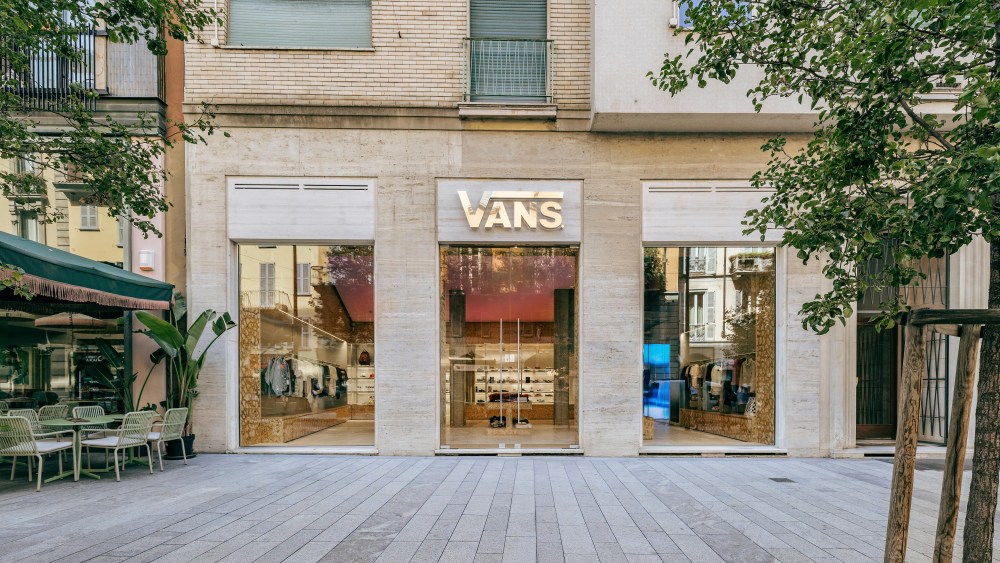
Vans occupies a unique position in VF Corp.’s portfolio — one where the balance sheet doesn’t require the brand to show growth.
That might be an odd way of looking at Vans’ contribution to the overall portfolio. But that way of thinking makes sense once one understands how VF thinks about healthy growth, and ultimately the “free” benefit that Vans contributes to the balance sheet.
“Obviously, there’s an option to get rid of the brand and actually make the balance sheet work, get to [profitable] growth faster. But we do like the optionality of holding on [to] the brand, really king of tempering it back into the right growth zone,” said VF’s Abhishek Dalmia, vice president, chief financial officer and chief operating officer. He made the comments on Tuesday at J.P. Morgan Chase & Co.’s Global Brands and Luxury Conference in Paris.
According to Dalmia, Vans was a $4 billion business “on the back of just five product silhouettes” that’s now down to $2 billion. It has a very big direct-to-consumer business, strong gross margin, but also a very high fixed cost infrastructure. And now that the business is right-sized, it would give VF the ability to have a “massive flow-through from a profitability standpoint” as soon as the decline is stabilized and “we start to temper into a slow growth mode for Vans. So, it’s a beautiful business,” he told attendees, adding that growth will come from a focus on product with the P&L starting to flow because of its fixed cost structure.
You May Also Like
“You don’t need Vans to deliver the VF P&L,” the CFO told investors. He explained that product growth from all VF brands in the right categories will grow organically and provide gains in market share. And newer products at higher elevated prices will fix the leverage ratio. He said the biggest pivot for the investor community then will be the realization that “Vans doesn’t need to grow substantially to make VF a great company again.”
VF’s chief executive officer Bracken P. Darrell said Vans’ order books keep showing improvement. He also noted the existence of brand heat as he spoke about opportunities for the brand, with improvement in men’s sneakers, men’s shoes and men’s footwear in general, as well as a “huge opportunity in women’s in footwear and apparel.
Darrell said when the company posted second quarter earnings results last month that it expects Vans to show improvement in the “second half.”
Darrell began the company’s presentation discussing the portfolio’s outdoor brands — The North Face, Timberland and Altria — and their growth prospects. The way he described it, the outdoor portfolio will “deliver significant growth and profitability … and then you get this bonus called Vans,” he said. “You get Vans basically for free. So, it wasn’t growing, it was declining [and] it was deleveraging us. Now it’s moving more and more towards not deleveraging anymore. And ultimately, it will lever us.”
For footwear, Darrel said Timberland has always had much more upside beyond where it was because “we got trapped into the historic yellow boot.” He described it as a “crazy cool brand” that has been “underexploited” because VF never aggressively went after expanding into new categories and giving people a place to go buy them. That is changing as VF is now “systematically expanding distribution in the U.S. with our own stores,” adding that the next opportunity is expansion in Europe.
And for Altra, known for its flatter running shoe with the wider toe box, VF’s CEO described the brand as a phenomena, with the business at $60 million when it was acquired and is now over $300 million. “I don’t see any reason why I can’t go to $1 billion plus, like Hoka or On.”